


Silicon carbon rods have high operating temperature, high temperature resistance, oxidation resistance, corrosion resistance, fast heating up, long service life, small high-temperature deformation, convenient installation and maintenance, and good chemical stability.
Equipped with an automated electronic control system, precise and constant temperatures can be obtained, and the temperature can be automatically adjusted according to the curve according to the needs of the production process. Using a silicon carbide rod for heating is both convenient and safe and reliable. It has been widely used in high-temperature fields such as electronics, magnetic materials, powder metallurgy, ceramics, glass, semiconductors, analytical testing, scientific research, and has become an electric heating element for tunnel kilns, roller kilns, glass kilns, vacuum furnaces, muffle furnaces, smelting furnaces, and various heating equipment.
Molybdenum disilicide electric heating component is a resistance heating component based on molybdenum silicide. It is heated to high temperature in an oxidizing atmosphere, and a dense quartz glass film is formed on the surface to protect it from oxidation. Therefore, it has unique high-temperature oxidation resistance. Under oxidation atmosphere, its maximum temperature can reach 1800 degree C, and its applicable temperature is 500-1700. It can be used as a heating component for industrial high-temperature furnaces such as ceramics, magnetic materials, glass, metallurgy, refractory materials, etc. Our company can produce various models such as U-shaped, W-shaped, straight rod shaped, and right angle shaped according to user needs.


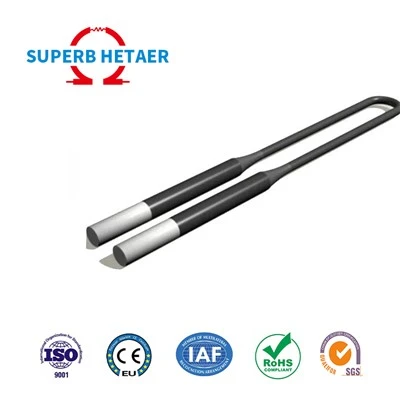


Our company specializes in the design and production of heating tubes for the industrial sector. With our own factory and a team of experienced designers, we have over 30 years of expertise in the manufacturing and design of heating tubes. Our team of professionals is dedicated to providing our clients with high-quality products that meet their specific needs and requirements.
Thermal conductivity: 20 kcal/meter · hour · degree
Linear expansion coefficient: 5 × 10⁻⁶ (m/ degree )
Silicon carbon rod components can react with oxygen and water vapor for long-term use above 1000 degree as follows:
① Sic+2O2 → SiO2+CO2 ② Sic+4H2O=SiO2+4H2+CO2
As a result, the SiO2 content in the components gradually increases, causing a slow increase in resistance and aging. If there is too much water vapor, it will promote the oxidation of SiC, and the H2 generated by the ② reaction will combine with the O2 in the air to form a vicious cycle. Reduce component lifespan. Hydrogen (H2) can reduce the mechanical strength of components. Nitrogen (N2) below 1200 degree can prevent SiC from oxidizing and reacting with SiC above 1350 degree , allowing SiC to decompose chlorine (Cl2) and complete the decomposition of SiC.
Molybdenum disilicide electric heating element is a heating element based on molybdenum disilicide (MoSi2), which has excellent characteristics such as high temperature resistance, corrosion resistance, good airtightness, heat shock resistance, and long service life. It can be used as a heating element for industrial high-temperature furnaces such as ceramics, glass, metallurgy, magnetic materials, and refractory materials.
1) The usage temperature is high. In an air environment, the usage temperature of the 1700 type component is 1700 degree , and the usage temperature of the 1800 type component is 1800 degree , and it can be used for a long time.
2) The fast heating rate can rise from room temperature to the temperature used for operation within a few hours, mainly due to the good thermal conductivity of MoSi2.
3) At high temperatures, it is not easily deformed or oxidized, mainly due to the small thermal expansion coefficient of MoSi2, and the formation of a SiO2 passivation layer on the surface at high temperatures to prevent further oxidation.
4) Low power consumption, compared to heating elements such as graphite electrodes, it can save more than 10% of electricity, mainly due to the lower resistivity of MoSi2, which is 2 × 10⁻⁵ Ω· cm.